Food Truck Trouble! Solve a Real-World Food Safety Mystery in Your Classroom
Why we wrote this new Food Safety Lab scenario:
This real-world scenario transforms students into public health investigators.
- Engaging storyline: Students work for the Department of Public Health, investigating a serious foodborne illness outbreak.
- Real-world application: Students learn to differentiate between pathogenic and non-pathogenic bacterial strains, focusing on the toxin-producing E. coli O157:H7.
- Essential molecular biology skills: Students will gain hands-on experience with crucial techniques:
- Micropipetting
- Polymerase Chain Reaction (PCR)
- Restriction Digestion
- Gel Electrophoresis
- Critical thinking: The lab promotes scientific inquiry, data analysis of multiple kinds, and evidence-based reasoning.
The science behind the solution: DNA restriction fragment length differences
Students will use a powerful sequence of molecular techniques to pinpoint the contamination source:
- PCR: They’ll amplify a 400 base pair E. coli DNA segment that differs between pathogenic and non-pathogenic strains. The template DNA is provided in the kit, and the PCR product is stable for days, offering scheduling flexibility.
- Restriction digestion: The restriction enzyme XmnI cuts the PCR product only if pathogenic E. coli O157:H7 DNA is present. Non-pathogenic DNA remains uncut. While overnight incubation is recommended, results are still conclusive with a minimum of 15 minutes to fit into shorter class periods.
- Gel electrophoresis: Students then visualize the DNA fragments. Pathogenic E. coli O157:H7 will show two bands (250 bp and 150 bp) due to the cut, while non-pathogenic E. coli will show a single 400 bp band. By comparing food samples to control samples, the contamination source is revealed.
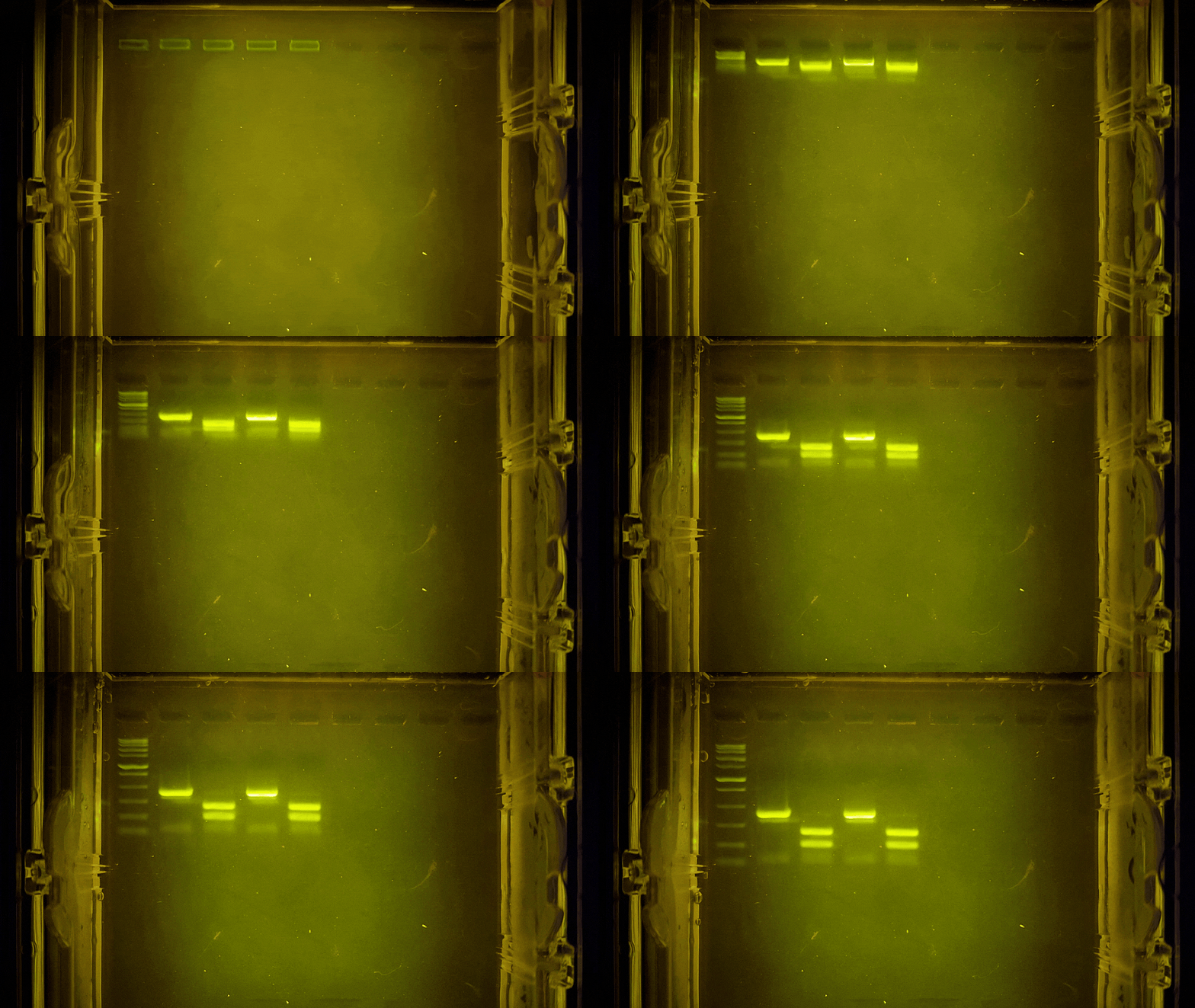
Teacher-friendly and fully supported
Designed with educators in mind, this lab offers:
- Flexible timing: Complete it in a single 2.5-hour class or spread it across multiple 40-min sessions.
- Reduced prep: Many teacher prep steps, like gel preparation and reagent dispensing, can be done up to a week in advance, saving valuable class time. The kit even recommends diluting the restriction enzyme for ease of pipetting.
- Safe but authentic: All DNA samples are synthetic and non-pathogenic, ensuring safety while providing an authentic scientific experience.
- Comprehensive resources: Includes detailed Instructor and Student Guides, e-worksheets, video tutorials for key techniques (micropipetting, PCR, gel electrophoresis), and alignment to standards like NGSS, TEKS, and others.
- Dedicated technical support: Questions? Just contact [email protected].
What you’ll need:
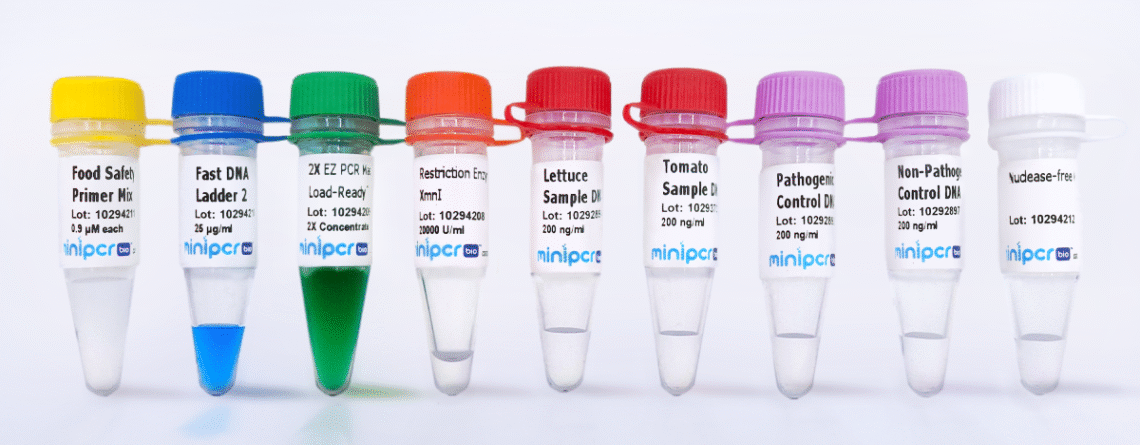
The Food Safety Lab kit (KT-1001-04) provides reagents for eight lab groups, including simulated DNA samples, Master Mix, Primer Mix, Restriction Enzyme, Nuclease Free Water, and Fast DNA Ladder 2.
You’ll need to supply:
- 2% agarose gels with fluorescent DNA stain (e.g., SeeGreen™ or GelGreen®).
- Plastic tubes (PCR and reagent distribution).
- A thermal cycler (e.g., miniPCR thermal cycler).
- A gel electrophoresis and visualization system (e.g., blueGel™ or Bandit™ systems with blue light transilluminator).
- Micropipettes and tips.
- Basic lab supplies like gloves, eyewear, markers, distilled water, and a microwave/hot plate.
Equip your students to be real-world scientific investigators. Bring the “Food Safety Lab: Food Truck Trouble!” into your classroom and empower them to solve the mystery!