miniPCR: From Your Bench to the Smithsonian Collection
A little over a decade ago, miniPCR bio was born out of an idealistic conviction: that the tools of modern biology shouldn’t be locked away in well-funded research institutions. We believed that if you made gene analysis tools compact, durable, and intuitive, you could put the power of DNA discovery into the hands of everyone, everywhere.
When Zeke and I wrote “everyone, everywhere,” we meant rural clinics, field biologists in the rainforest, and middle- and high-school science classrooms.
We never imagined orbit.
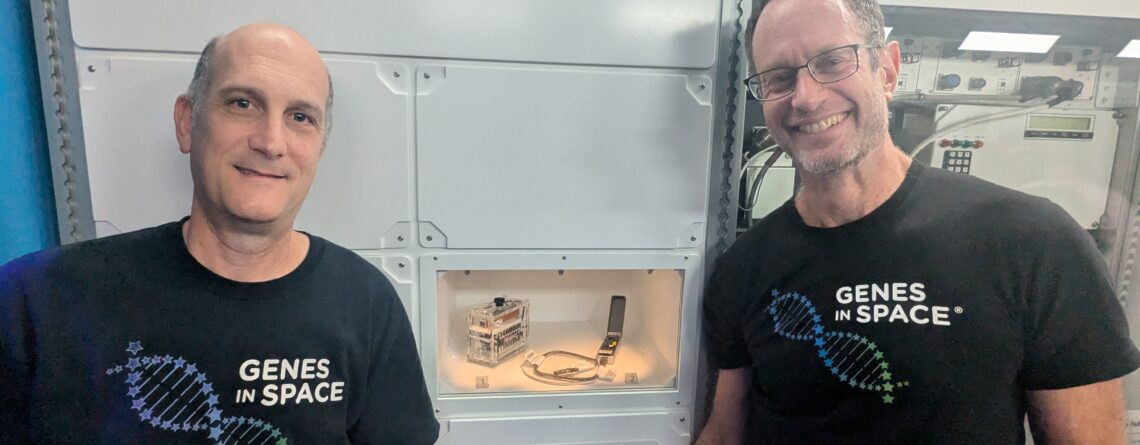
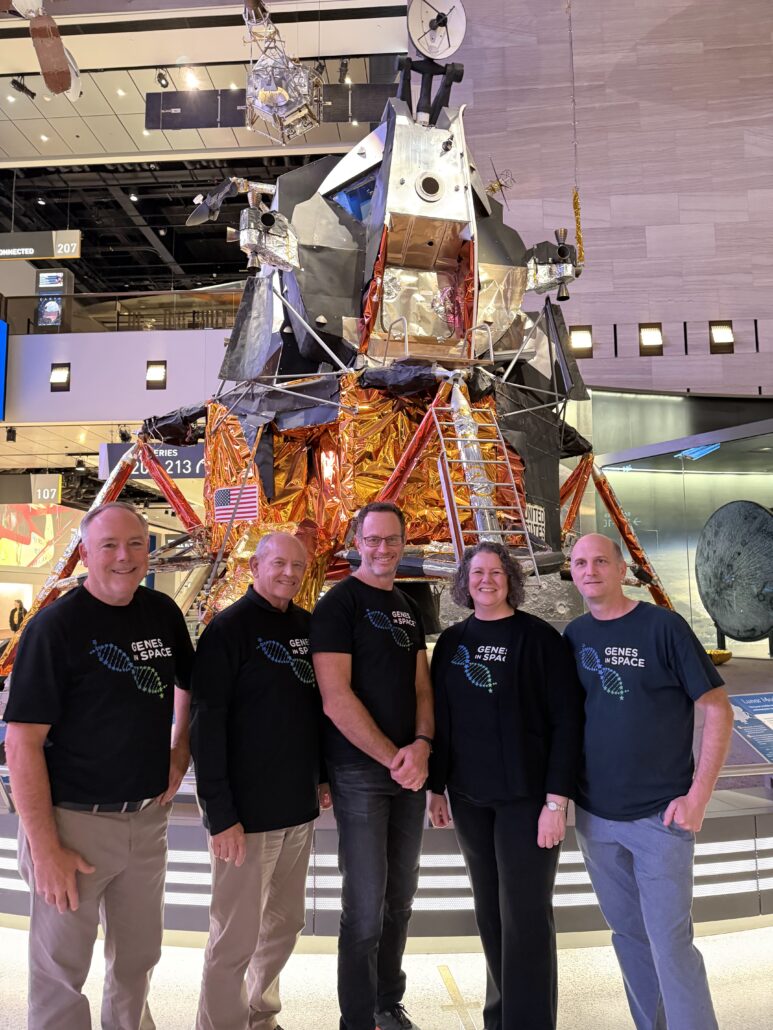
Last week, we reached a milestone that still feels somewhat surreal: a miniPCR thermal cycler that flew aboard the International Space Station officially entered the permanent collection of the Smithsonian National Air and Space Museum as part of At Home in Space, their latest exhibition.
Seeing our little transparent box sitting inside a Smithsonian glass case—alongside artifacts from the Apollo era and the giants of flight history—is an incredible honor. It is a high point in an audacious, decade-long collective journey. This honor belongs to:
- The entire miniPCR bio team, who pour their hearts into engineering hardware that simply does not quit, whether it’s sitting on a tenth-grade lab bench or rocketing through the atmosphere.
- Our founding partners at Boeing, especially Scott Copeland and Kevin Foley, who had the vision to look at an early prototype on a Boston cocktail table in 2014 and imagine what it could do in microgravity.
- Our steadfast champions at the ISS National Laboratory and New England Biolabs, who helped turn a bold technology demonstration into Genes in Space—a program that has empowered over 13,000 young scientists to steer the research agenda of low Earth orbit.
Most of all, this honor belongs to you. To the countless students and educators who prove daily that the scientific frontier doesn’t belong to credentials or titles; it belongs to curiosity.
During the induction ceremony at the Smithsonian, I had the privilege of sharing the story of how a small startup joined humanity’s quest for space exploration. I wanted to share the transcript of those remarks with our wider community—because every teacher who runs a gel in their classroom, every mentor who guides a student, and every engineer on our team is part of this story, which is still being written.
Ad astra.
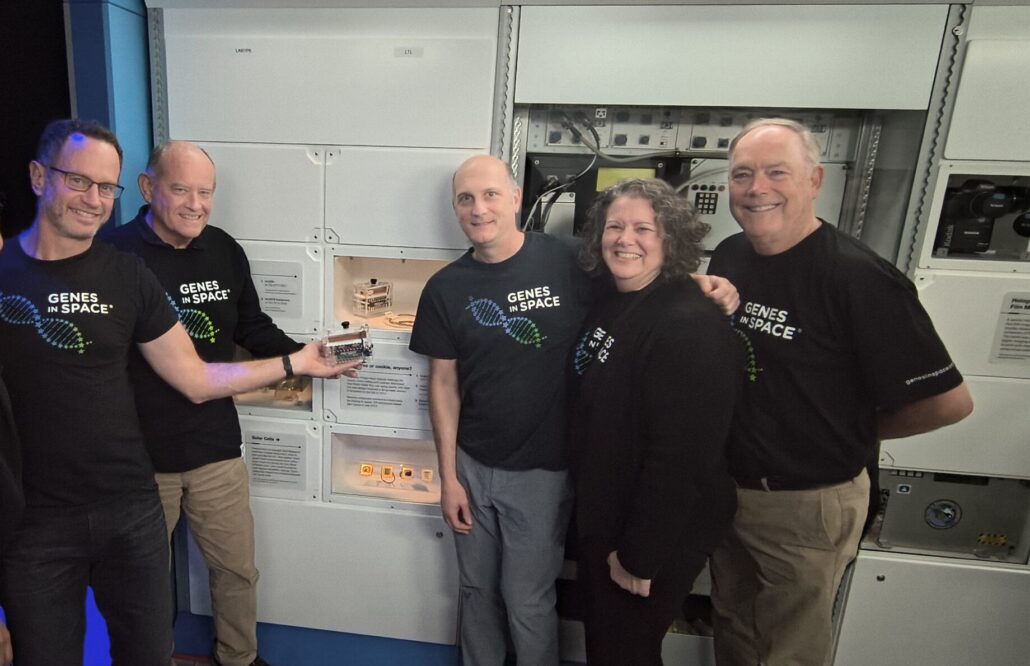
Remarks Delivered by miniPCR at the Smithsonian National Air and Space Museum
(Washington, D.C.)
For more than 25 years, we have been at home in space.
It started in November of 2000, when 3 astronauts floated into the belly of the International Space Station as part of Expedition 1, opening the era of permanent human presence in low Earth Orbit. This was an extraordinary achievement: an orbiting laboratory, built through international cooperation, where humans could live and work in an environment unlike any on Earth.
Just a few months earlier, also in 2000, we reached another extraordinary scientific milestone. Scientists announced the first draft of the human genome—the roughly three billion letters of DNA that make us human.
In the span of a few months, humanity had achieved two staggering milestones. One project was extending human presence beyond Earth. The other was helping us understand life at its most fundamental level.
Yet for nearly fifteen years, these two historic frontiers traveled on strictly parallel tracks.
When it came to biology, the orbital laboratory of the ISS depended on a very expensive courier system. If an astronaut wanted to study how life in space affected our cells, or the microorganisms that travel with us, the process was painstaking: they’d have to freeze biological samples, bag them, load them onto a return capsule, wait months for it to splash down in the ocean, and wait until a courier drove the vial to a lab. We were living in space, but we couldn’t fully interrogate the impacts space was having on our biological makeup at the most fundamental level.
“Sebastian, I met someone from Boeing. They want to put our miniPCR in space.”
From today’s vantage point, I can clearly see how those two endeavors would become closely connected. Genetics and space exploration were like two deep-space probes on converging trajectories. But back in the summer of 2014, I had no idea their paths were about to cross—let alone that my team and I would be in the control room at the moment of their rendezvous.
I was in Boston, running a fledgling, one-year-old startup called miniPCR bio with my cofounder, Zeke Alvarez Saavedra. Our mission was ambitious but simple: to bring the power of DNA analysis to everyone, everywhere. We did that by making the tools of genetic analysis small, portable, and easy to operate from a smartphone.
When we said “everyone, everywhere,” we meant farms, the rainforest, your kids’ classroom, or your kitchen counter. And quite honestly, our business plan did not include space.
But one evening that summer, Zeke brought our little DNA analysis machine to a technology showcase. MassChallenge, a startup accelerator based in Boston, hosted its final demo day. We had been working really hard that summer at MassChallenge, and I was so exhausted that I skipped the gala. Zeke went alone.
“Yes, this one I think we can fly.”
If you know Zeke, you know he is a brilliant scientist whose default emotional status is calm, measured, and very understated. So I was surprised when Zeke called me that night sounding jittery with cosmic excitement.
He said: “Sebastian, I met someone from Boeing. They want to put our miniPCR in space.”
I thought he was joking.
Zeke had crossed paths with Scott Copeland and Kevin Foley. Scott was a veteran aerospace engineer scouting new technologies for Boeing and the ISS National Laboratory. And Scott saw the problem: the International Space Station needed molecular biology capabilities, but standard laboratory equipment was the size of a microwave, power hungry, and too delicate to survive the forces of a rocket launch.
Scott had held the miniPCR in the palm of his hand, and admiring its simplicity, literally said in a very Scott kind of way, “Yes, this one I think we can fly.”
Zeke and I thought: Our little miniPCR machine? Built by our startup out of a Cambridge basement? This can’t be real.
But a few weeks later, a formal invitation arrived via email. And then the real work kicked in.
—
Here on Earth, if a lab instrument has an issue, you call a technician for service, or borrow one from the lab next door. On the International Space Station, there is no technician coming to do repairs on orbit, there are no spare parts. The miniPCR had to endure the acceleration and vibrational loads of launch. And, if you know how a PCR machine works, switching temperatures repeatedly from hot to cold, it had to precisely manage heating and cooling cycles in microgravity, where the lack of convection changes how heat travels.
It also had to operate safely in the hands of astronauts who are world-class pilots and flight engineers, but who aren’t necessarily trained molecular biologists running PCR every day.
Every circuit board, wire harness, housing material, hot surface, every hinge and potential pinch point, and even the software had to be meticulously examined through safety, outgassing, and electromagnetic reviews. Every watt of power consumption had to be accounted for. Scott’s team at Boeing guided us through that process with patience and rigor.
This was demanding work, but ultimately straightforward: physics, electrical and mechanical engineering, and software hoops to jump through.
[Boeing and ISSNL] asked us the ultimate question: What are you going to test with it?
Strangely enough, passing those engineering tests wasn’t the hardest part.
The hardest part was waiting for us on the other side of flight certifications… Because once Boeing and the ISS National Lab said, “Yes, your miniPCR can fly,” they looked at us and asked us the ultimate question:
What are you going to test with it?
Imagine the weight of that question. Up until that point, no one had ever tested DNA in space. Not Apollo. Not Skylab. Not the Shuttle program. The history of spaceflight had been waiting for that page to be written.
Zeke and I looked at each other, a bit exhilarated, a bit panicked. If we accepted this invitation to fly our technology to space, were we tasking ourselves with writing the first page in the book of DNA exploration in space?
We felt this complete sense of humility—that we shouldn’t be the sole deciders of such a meaningful scientific turning point.
We needed help. And we realized: our mission at miniPCR was about putting powerful tools in the hands of curious people. And where do you find the purest, most fearless curiosity on the planet?
In classrooms.
Teenagers. We decided to let middle schoolers and high schoolers, curious minds brimming with wonder and unencumbered by the fear of failure, decide for us.
So, alongside Boeing, we launched a crazy bet called Genes in Space. The premise was super simple: You tell us what question we should ask in orbit. You design an experiment. If your experiment wins, we launch it to the International Space Station. We were joined in this wild dream by extraordinary partners like New England Biolabs and the ISS National Laboratory.
We hoped to inspire a few students to step up and take charge of the science, so we offered them a deal. We had no idea what kind of scientific passion we were about to ignite.
—
Our inaugural winner in 2015 was Anna-Sophia Boguraev, a high school junior from New York. Anna-Sophia looked at the harsh realities of space travel and asked a profound question: Does spaceflight alter the immune system at the epigenetic level?
On April 19, 2016, British astronaut Tim Peake loaded Anna-Sophia’s experiment into our little machine aboard the ISS and pressed “Run”. And hers became the first successful PCR experiment in space. At age 16, her scientific drive opened a new frontier for space biology. Anna-Sophia is now an MD-PhD student in Boston, training to become a physician scientist.
Following in Anna’s footsteps, Genes in Space students rose to the challenge year after year.
In 2018, four Minnesota high schoolers—David Li, Michelle Sung, Aarthi Vijayakumar, and Rebecca Li—designed an experiment using CRISPR, a powerful tool for editing DNA, to investigate how cells repair genetic damage. Their work led to the first use of CRISPR gene editing aboard the space station. These students were investigating a fundamental challenge of deep-space travel: how to protect astronauts’ DNA from radiation.
Further winners designed the first molecular diagnostic in space. They explored how spaceflight affects biological clocks, the length of their telomeric DNA. They optimized on-demand biomanufacturing and many other molecular processes.
These flown experiments are just the tip of a phenomenal iceberg. More than 13,000 students have participated. Twelve student-designed experiments have flown to the station, contributing to nine peer-reviewed scientific publications. In 2026, a record 1,317 students submitted 980 proposals. Our newest winners this year, Serena Tsao and Chloe Comisarow, will investigate whether stress-related changes in the human microbiome contribute to kidney stone formation in astronauts.
These student achievements also paved the way for genetic testing to become a permanent operational reality in microgravity. The space station is a habitat. A sealed, living ecosystem shared by crew members and microorganisms alike. And NASA researchers—led by pioneers like Dr. Sarah Wallace—now routinely use portable DNA sequencing to monitor the microbial environment on station surfaces and in the water supply. Instead of waiting for sample returns, astronauts can track microbial communities, assess crew health, and safeguard their environment in real time.
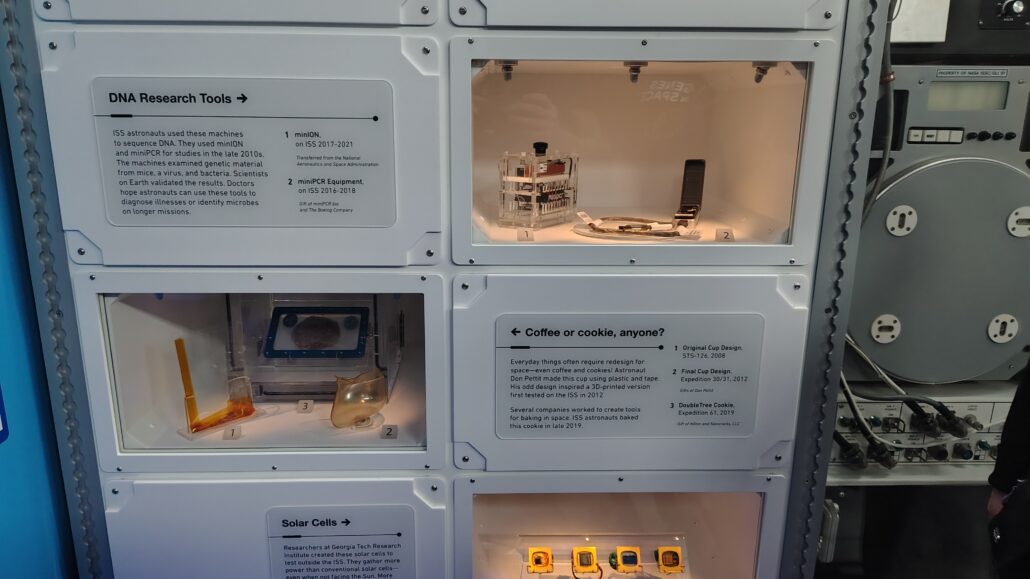
Today, we’re all gathered at this magnificent exhibit to celebrate that we’re “at home in space.” And what does it mean to be at home? You’re at home when you are not only living in space, but you’re there doing the things that define humanity. You’re asking questions and seeking answers.
That is exactly what the thousands of students of Genes in Space remind us year after year: that we are all at home and welcome at the scientific frontier; that scientific challenges belong to anyone who can ask a fearless question.
“The frontier does not belong to institutions or credentials. It belongs to anyone with the courage to ask a fearless question.”
When visitors walk through these galleries they will see giant rockets, lunar landers, and spacesuits dusted in the glory of Apollo. And right alongside those, they may see this little miniPCR box.
I hope that you and all the other visitors looking at the incredible artifacts in this exhibit don’t see them as the glorious relics of a finished chapter in the history of space exploration. I hope instead that you will see an open invitation. An invitation to ask a question, to dream, and to reach high and far into the unknown. I hope you see that you, too, might help write the next chapter of human exploration
Thank you.
—
Looking Forward
As we celebrate this induction, our eyes are still on the bench. The miniPCR on display in Washington has finished its flight missions, but thousands of its siblings are powering up right now in classrooms across the globe, in field stations on remote continents, and in community labs.
To everyone who has been a part of this journey—our team, our partners, our Kickstarter backers, the teachers who champion real science, and the students who dare to ask the hardest questions—thank you. We couldn’t have done it without you, and the next chapter is just getting started. In your hands.